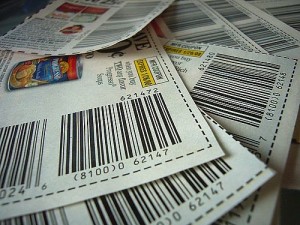
The previous information about the coding of coupons is outdated, and is no longer available. Please see the new information about the GS1 Databar barcode on coupons.
Wondering how the stores are reimbursed for their coupons? Check out this information:
Coupon Redemption Process
- Manufacturers design coupon promotions with their sales/marketing teams.
- Coupons are distributed via newspaper inserts, direct mail campaigns, via the Internet, etc.
- A couponer excitedly enters the store and proudly uses all of his/her coupons at checkout.
- The cashier scans the coupons and puts them into the cash drawer. Typically, at the end of the day, the coupons in each cash drawer are added up as if they were cash, and that amount is added to the cash sum to be sure the overall total for the drawer is accurate.
- Once per week, all of the manufacturers coupons (and any coupons issued by the grocer) are sent in plastic bags or pouches to the store’s corporate headquarters.
- There is a very lucky person at headquarters in charge of processing the coupons. That person boxes all of the bags of coupons and ships them to a third-party clearinghouse.
- The clearinghouse is then responsible for doing the most important part of the coupon redemption process: separating the coupons by manufacturer or by scannable coupons versus damaged/torn coupons. Most of this process is done by hand. Sometimes coupons are put face up on a conveyor belt and move under a scanner that reads the UPC codes and tallies the amounts. However, damaged and torn coupons have to be tallied by hand. The clearinghouse then sends all the sorted coupons with an invoice to the manufacturer.
- The manufacturer will reimburse stores the face value of coupons, or if the coupon calls for FREE merchandise, for the retail-selling price up to the stated maximum value printed on the coupon plus 8¢ for handling each coupon properly redeemed (this 8¢ value may vary slightly). Many times manufacturers, such as ConAgra Foods, will also reimburse retailers that are using a clearinghouse or billing agent at a rate equal to $5.50 per thousand of coupons redeemed.
- The manufacturer either reimburses the clearinghouse for the amount of the invoice, and the clearinghouse mails a check to the store for the amount of the coupons, or the manufacturer sends a check directly to the store and the store then pays the clearinghouse. The clearinghouse is paid a certain amount per coupon by the store, plus shipping and handling.
You can also view a visual diagram of the coupon life cycle and check out an example of the coupon redemption policy for ConAgra Foods.
2009 Coupon Use Facts
- With a sour economy, consumers used 27% more coupons in 2009.
- Brands issued 367 billion coupons, at an average face value of $1.44. That’s a total of $528.5 billion!
- Out of those coupons above, a total of $3.5 billion worth of coupons were redeemed. That sounds like a lot, but compared to the $528.5 billion that were available, that’s less than 0.7%!